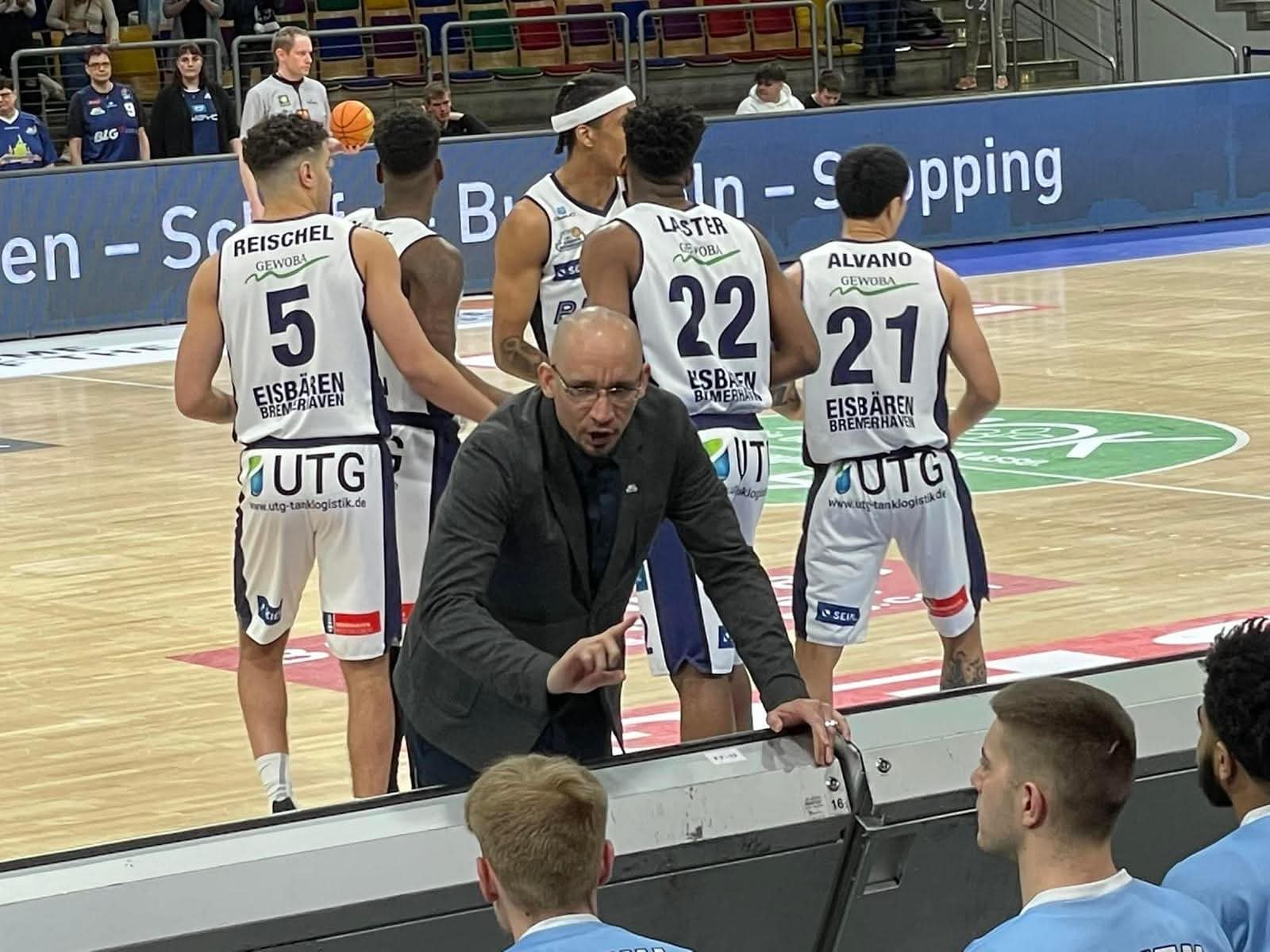
Allen Smith began his coaching career in 2013 with the Linden Dudes woman´s team in the 2 Regionalliga. He then coached TSV Neustadt and then went to his former playing team Hannover Korbjager. He then went back to TSV Neustadt and led them to the 2 Regionalliga title in 2017. He then was assistant coach with Pro A team Eisbaeren Bremerhaven from 2019-2022. He took over as head coach in the stretch run of the 2021-2022 season where he had a 6-2 record and led the team into the playoffs. He then was a season with the Artland Dragons organization where he coached the women. Since 2024 he is head coach of TSV Neustadt. He spoke to germanhoops.com about his coaching career.
After your playing career you moved into coaching, beginning with the Linden Dudes women’s team. How did that happen?
Coaching was probably inside me long before I stopped playing.
I was fortunate to be around coaches like Zack Jones, Kwabene Robinson and James Stewart very early in my life, and they made me want eventually to give back to players the way they had given to me.
The transition accelerated after my injuries.
I wanted to remain around basketball and stay in Germany, and the Linden opportunity was in Hannover, so it made sense.
What began as the next basketball opportunity quickly became confirmation that teaching and developing people was something I wanted to push as far as I could.
Was coaching women a big adjustment?
The biggest adjustment wasn’t really coaching women.
It was learning that coaching is not simply establishing a standard and telling players to reach it.
That team had players with serious lives outside basketball. I think around half were studying medicine. Basketball represented competition, but also community, fitness, learning and enjoyment.
I learned that you can maintain a high standard while still meeting people where they are.
We struggled early, but we kept building belief and eventually became a very competitive team at a level where many people doubted we belonged.
That season taught me one of my most important lessons: sometimes the coach has to be the steady captain while everybody else is experiencing the storm.
You were Team Manager with MHP RIESEN Ludwigsburg. Did John Patrick give you the final push toward coaching?
My official title was Team Manager, but my daily involvement was much broader than people might assume from that title.
I worked between the players, coaching staff, management, medical staff and physiotherapists. I was involved in practice preparation, organization, player logistics and many of the things required to keep a professional team functioning.
I also spent a lot of time doing extra individual work with players who wanted it.
Something John Patrick told me has always stayed with me. He appreciated my ability to recognize something that wasn’t operating at a high level and, instead of complaining about it, simply find a way to bring it to the required level.
John is extremely demanding and methodical. Working successfully in that environment gave me confidence that my standards and basketball understanding belonged in a high-level professional organization.
Ludwigsburg was where a lot of my previous experiencescorporate operations, playing, injuries, player development and leadershipfinally came together.
Do you have any good stories about the Ludwigsburg players?
One that always stays with me involves Kerron Johnson.
He arrived very late before the season, and I was tasked with helping get everything around him readymedical requirements, licensing, apartment, transportation, understanding the organization and additional basketball work.
We had very little time before the opening game against Bonn.
Then he went out and scored 38 points.
I’m definitely not taking credit for Kerron scoring 38he was the one on the floor doing it.
What the experience showed me was that I could help remove enough noise around a high-level player that he could focus completely on performing.
That became another important lesson for me: high performance isn’t only the two-hour practice. It’s an ecosystem.
You then became head coach of Hannover near the end of the 2015–16 season. What do you remember about that first men’s head-coaching experience?
That was Hannover Korbjäger in the 1. Regionalliga Nord.
At the time I was already working as an assistant coach with Neustadt one level below, and the Hannover opportunity came up late in the season.
The situation was somewhat chaotic. There were good individual pieces, but the team wasn’t functioning consistently as a group.
For me it was an opportunity I couldn’t turn down. I was being given the chance to become a head coach one league above where I was assisting.
We finished the season competitively, and the club later withdrew for reasons outside the basketball side.
What that experience gave me was my first real understanding of what it feels like when the final decisions and results have your name attached to them.
You became head coach of TSV Neustadt in 2016 and won the 2. Regionalliga title immediately. What was special about that team?
We didn’t accidentally discover halfway through the year that we could win it.
We built that team with the championship as the goal from the beginning.
We had experience, talent and guys who genuinely liked being around each other. There was a family feeling to the group.
And our culture was very much “whatever it takes.”
I was living in Hannover, about 30–40 minutes from Neustadt, and there were days when I’d literally fill my car with four players, drive everybody to practice and then take everybody home afterward because having the right people in the gym mattered more than whose responsibility transportation technically was.
That mentality became part of who we were.
You were reunited with Tobias Welzel and had Solomon Sheard. How important were they?
Solomon was invaluable.
At around 6’8″, 240 pounds, left-handed, physical and athletic enough to move, he gave us a matchup problem that was extremely difficult to solve at that level. He had already been important in Neustadt for years and also a close friend of mine.
Tobias was different because we already had history.
When I played for Hannover, I was the veteran and Tobias was the younger German coming through. I had watched him develop and tried to help him during that period.
Years later, coaching him felt like the next chapter of that relationship.
Those two gave us talent, trust and continuity that couldn’t simply be replaced by signing another player with similar statistics.
You coached Neustadt legend Dyon Doekhi and saw him become a Neustadt lifer. What was so special about his game and character? Do you sometimes wonder how far he could have gone had he left earlier in his career?
Dyon came to us at exactly the right moment, both for the team and probably for himself.
He had already played in different countries and situations, and I think what he needed at that point was somewhere he could stabilize, be trusted and play within a group that had enough quality around him to allow his game to really come out.
Basketball-wise, he gave us experience, scoring, leadership and confidence. But what became just as important was everything that developed away from the court.
We had a lot of conversations about basketball philosophy, coaching, the business and what life after playing might eventually look like. I think seeing how I approached coaching sparked something in him as well, and over time our relationship became as much mentor-player as coach-player.
Could he have played higher? Absolutely. I thought he could play Pro B and potentially Pro A basketball if the right opportunity and timing had come together.
But careers aren’t only about chasing the highest league possible. Sometimes finding stability, community and a place where you can fully become yourself is equally important. Neustadt became that for Dyon.
What I’m probably most proud of is that he didn’t only become an important player there. He became part of the community and started investing his own knowledge back into other players. That’s a different kind of success.
You also coached Mubarak Salami, who tragically died in a car accident. What memory of him will always stay with you?
Mubarak was very special to me.
It’s difficult for me to reduce Mubarak to one memory.
What I remember most is the contrast between who he was on and off the court.
On the floor, he was fearless. He had natural instincts that you don’t really teach and a willingness to compete that immediately connected with me. A lot of people had already formed opinions about him by the time he came to us. Some coaches even told me I shouldn’t take him.
But I didn’t see a problem player. I saw somebody who badly wanted to become something and hadn’t yet found the environment or language that helped him understand how to get there.
We worked a lot on his body, coordination and understanding of the game, but I also wanted to protect the part of him that played instinctively. I talk a lot about playing from your heart spacedeveloping skills and understanding deeply enough that eventually you can stop thinking about basketball and simply play. Mubarak really embraced that.
Off the floor he was completely different from the competitor people saw during games. He was incredibly kind. He cared deeply about kids and about his younger brothers and sisters. He carried a lot of responsibility in his family.
I think one of the things our relationship gave him was a place where he didn’t always have to be the caretaker. Around me he could still be a young player who needed guidance, could ask questions, make mistakes and trust that somebody genuinely wanted the best for him.
Our relationship became much closer to family than simply coach and player. I always looked at him almost like a nephew.
Basketball-wise, he was also one of the first players I invested that deeply into and then watched become a high-level professional player. Years later he became one of the leading scorers in the ProB, and seeing that development meant a lot to me.
So when I think about Mubarak, I don’t think first about one game or one statistic. I think about the conversationsserious ones, funny ones, basketball onesand about a young man who trusted me enough to let me help him become more of who he already had inside him.
That’s what I will always remember.
I miss him.
You also coached Hannover United wheelchair basketball. What was that experience like?
One of the first things I learned was actually pretty funny.
I didn’t know non-disabled players could participate in German wheelchair basketball. After one game an opposing player stood up from his wheelchair and walked away, and I started telling everybody the other team was cheating.
The Hannover United players were dying laughing because they knew the rules and I didn’t.
Once I understood the game, I became fascinated by how much basketball transferred.
Pick-and-roll, spacing, screening and transition were still basketball. But wheelchair basketball also exposed me to concepts that standing basketball wasn’t really using much yet, such as immediately making contact after a shot to slow the opponent’s transitionsimilar to what people now call tagging up.
Most importantly, I coached those athletes to professional standards.
I never wanted “I can’t” to become the answer. Usually it’s either, “I don’t know how yet,” which we can teach, or, “I’m not willing to do what it requires yet,” which we can address.
One preseason we even participated in a Guinness World Record challenge pulling more than 50,000 kilograms of vehicles over 100 meters as a group.
The point wasn’t really the record.
It was showing people that the limits they believed existed were sometimes much further away than they thought.
You spent three years with Eisbären Bremerhaven, first as an assistant under Michael Mai and later taking over. How valuable were those years?
Extremely valuable.
Moving from being a head coach in Regionalliga into a full-time ProA environment gave me another level of daily basketball education.
My responsibilities included opponent preparation and a lot of individual development work with the professional players.
Being immersed in that environment every day forces you to sharpen everythingscouting, communication, preparation, player management and the details of winning.
Michael and I had already known each other from my playing days in Hannover, so there was history there as well.
Those three years helped me articulate much more clearly what I believed as a coach and gave me an understanding of what ProA-level players need on a daily basis.
You coached Kevin Yebo in Bremerhaven. What do you think those two ProA years gave him before he returned to the BBL and eventually reached EuroLeague level?
Kevin’s physical tools were always obvious.
What a player sometimes needs isn’t simply a higher league. He needs responsibility, repetitions and enough space to experience situations repeatedly until the game slows down.
I think those ProA years gave Kevin exactly that.
He could play meaningful minutes, make mistakes, learn how teams adjusted to him and understand how his physical advantages translated against professional competition every night.
Sometimes taking one step back in level is actually taking two steps forward in development.
His career afterward speaks for itself.
You took over Bremerhaven in early 2022 and went 6–2 to reach the playoffs. What do you remember about that run?
The urgency.
When I took over, there wasn’t time to reinvent everything.
I already knew the roster because I had been the assistant, so my responsibility was to create clarity, restore belief and put guys in positions where they could play with confidence.
We won six of the remaining eight games, including the final five, and reached the playoffs against Tübingen.
That run was personally very important because it gave me confirmation at another level.
I had already believed I could lead professional players. Now there was tangible evidence that I could take responsibility for a ProA team under pressure and get results.
We didn’t want simply to make the playoffs, but getting there from that position is something I’ll always be proud of.
You then spent time with Artland in the youth program and women. What did you take from that experience?
It broadened me again.
Working across different ages and with different groups reinforces something I strongly believe: the patterns of personal development are remarkably similar, but everybody is at a different stage.
The coach has to recognize where the person actually is.
With younger players especially, you can’t hide behind complicated basketball language. If you can’t teach something clearly, you probably don’t understand it as well as you think you do.
Artland reinforced the importance of fundamentals, communication and adapting the method without lowering the standard.
You returned to TSV Neustadt in 2024. How difficult was that first ProB season, and what did you learn?
Very difficult, but extremely valuable.
I initially returned in an assistant role and took over as head coach after the team had started the season with nine straight losses in its first ProB year.
When you inherit a situation like that, the table can’t be your only measurement.
The first job is rebuilding belief, creating professional habits and getting players to compete with clarity again.
We became much more competitive, but the start had put us in a very difficult position and we couldn’t completely overcome it in the standings.
What I learned is that meaningful change sometimes happens before the table is capable of showing it.
You have to keep coaching the process even when the external reward hasn’t arrived yet.
Last season you started 7–0, then lost eight in a row, recovered to make the playoffs and lost two close games to Coburg. How do you summarize that season?
It almost felt like three different seasons.
Starting 7–0 showed us our ceiling.
Losing eight straight showed us every place where our foundation still wasn’t strong enough.
That stretch exposed thingsturnovers, defensive rebounding, emotional discipline, late-game execution and how we responded when confidence was challenged.
The thing I’m proudest of is that we didn’t break.
We won three of our final four games to qualify for the first ProB playoffs in club history.
Then against Coburg, the second-place team from the South, we showed we belonged. Both games were competitive and the second ended 75–77.
I’m proud of the season, but not satisfied.
The lesson was that talent can give you a great start. Character, clarity and trust are what allow you to survive the middle and still be standing when the important games arrive.
What are the team’s goals and your personal goals this season? Are the playoffs the goal again?
The playoffs absolutely matter, but I don’t want them to become the ceiling.
Our goal is to become one of the most prepared teams in the league.
By the important part of the season I want us to have clear roles, be physically prepared, mentally and emotionally strong, hungry to execute and completely trusting one another.
If we build those things properly, the standings will take care of themselves.
Personally, I want to continue demonstrating that I can build, develop and lead professional teams at increasingly higher levels.
I’m ambitious about where my coaching career can go, but ambition only matters if I’m doing the job in front of me at a very high level.
So right now my focus is helping Neustadt take another meaningful step forward.
Please list your personal NBA and European coaching Mount Rushmore.
Zelko Obradovic
Pablo Lasso
Gregg Popovich
Erik Spoelstra
Thanks Allen for the chat.

