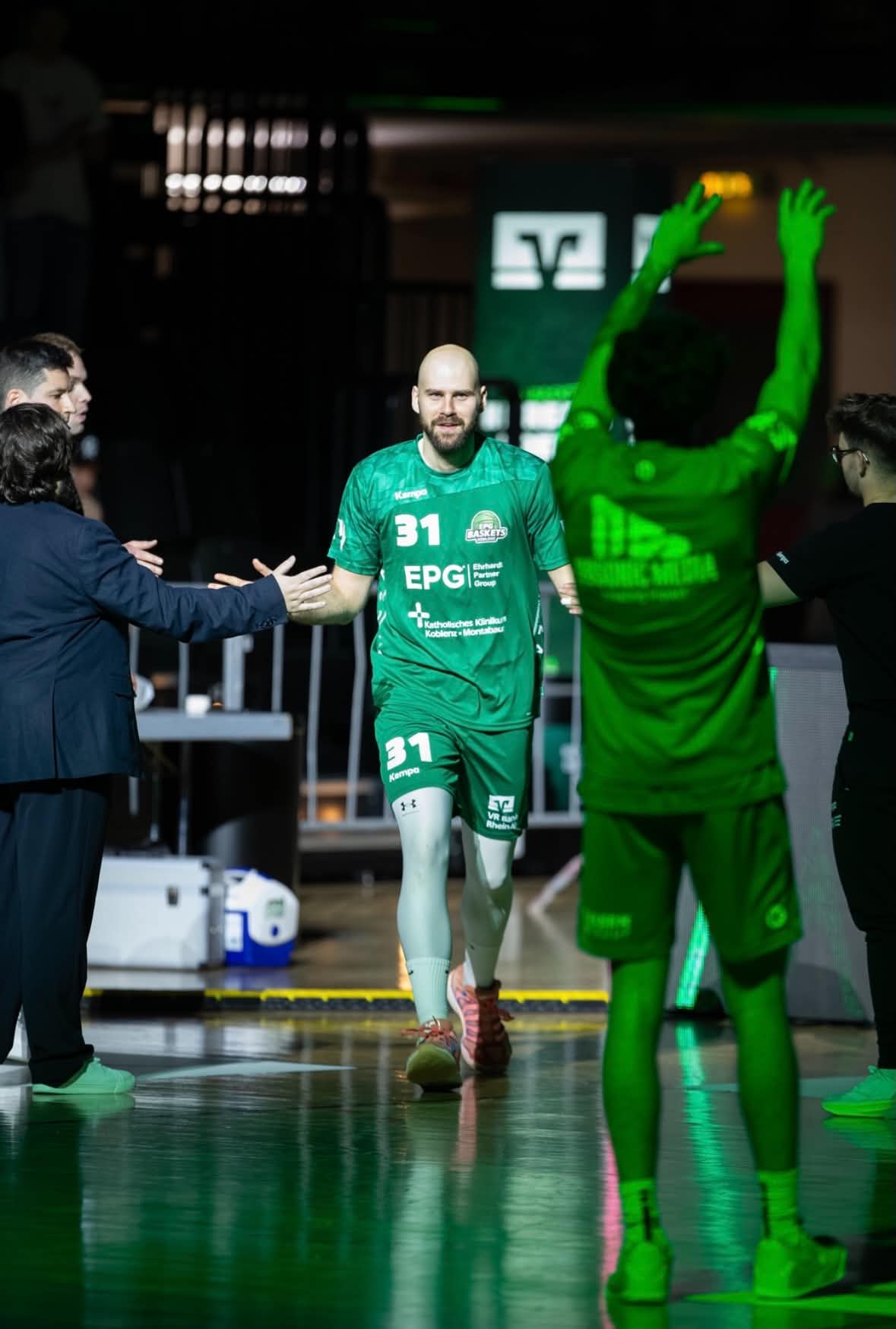
Pic Credit Angel Media
Dragos Diculescu (196-G/F-1999, agency: One Motive Sports) is a 27 year old 196cm guard from Romania playing his second season in Germany and first with Pro A club EPG Baskets Koblenz. He played his first season in Germany in 2024-2025 with the BG Hessing Leitershofen (Germany-Pro B) averaging 18.8ppg, 5.8rpg, 4.5apg, 1.5spg, FGP: 63.1%, 3PT: 35.3%, FT: 74.1%. Last season he palyed with the Koping Stars (Sweden-Basketligan) averaging 16.1ppg, 5.7rpg, 4.1apg, FGP: 52.7%, 3PT: 34.2%, FT: 87.4%. He began his basketball career in his native Romania and palyed with teams like Steaua CSM EximBank Bucuresti (Liga Nationala), BC Timisoara (Liga Nationala), and SCM CSU Craiova (Liga Nationala. He then played 2 seasons with Landstede Basketbal Zwolle (Holland-DBL). He spoke to germanhoops about basketball.
Last season you played with the Koping Stars (Sweden-Basketligan) averaging 16.1ppg, 5.7rpg, 4.1apg, FGP: 52.7%, 3PT: 34.2%, FT: 87.4%. What kind of an experience was the league and country and what was the difference in the tough sweep loss against Jamtland?
My experience in Sweden was a very positive one, even though it came with challenges. I joined the team later in the season, so there was an adjustment period for everyone, but over time we found the right chemistry and identity. What I am most proud of is the adaptability we showed as a group and the way we managed to turn the season around and earn a playoff spot. The Swedish league was highly competitive and played at a very fast pace, which I enjoyed. It challenged players to make quick decisions and adapt constantly, and I believe that helped me continue developing my game. As for the playoff series, the final result says we were swept, but the reality was more nuanced. The first two games on the road were decided by a single possession, and in both we had opportunities late in the game to put ourselves in a position to win. Against a team of Jämtland’s quality, those moments are crucial. When you don’t take advantage of those opportunities, the margin for error becomes very small. Of course, the outcome was disappointing, but that series reinforced an important lesson: at the playoff level, the difference between being up 2-0 and down 0-2 can come down to just a few possessions. That’s what makes those games so demanding and so rewarding at the same time.
In the 2024-2025 season you played with BG HessingLeitershofen (Germany-ProB) averaging 18.8ppg, 5.8rpg, 4.5apg, 1.5spg, FGP: 63.1%, 3PT: 35.3%, FT: 74.1%. You were swept by the ETB Miners Essen in the playoffs. How do you summarize that season? Did the team underachieve a bit that season?
I wouldn’t describe that season as a disappointment. We were a young team that finished first in the regular season and played a style of basketball that we were proud of throughout the year. Unfortunately, injuries had a significant impact on us at the most important stage of the season. Losing key players and having others limited physically meant that we had to adjust roles and change the way we played right before the playoffs, which is never easy. Of course, being eliminated in the first round was not the outcome we were hoping for, but that’s part of sports. Looking back, I choose to remember the growth of the team, the success we had during the regular season, and the lessons that came from facing adversity. Every season, whether successful or not, gives you something to build on, and that year was no different.
In the 2023-2024 season you split time with CSM Constanta (Liga Nationala) averaging 12.4ppg, 4.7rpg, 2.2apg, 2FGP: 47.9%, 3FGP: 45.0%, FT: 63.2%; and in Dec.’23 moved to Hamar (Iceland-Subway League) averaging 18.4ppg, 7.4rpg, 2.3apg, 1.2spg, FGP: 51.4%, 3PT: 34.8%, FT: 78.6%. How did you experience Iceland? What was your coolest moment off the court in Iceland?
My time in Iceland was a unique experience both on and off the court. From a basketball perspective, I was challenged by the speed and intensity of the league. It was an environment that pushed me to adapt, and I believe that learning to succeed in different styles of basketball is an important part of a player’s development. Off the court, what stands out most is the country itself. Iceland gave me the opportunity to experience some incredible natural landscapes, from waterfalls and geysers to seeing the Northern Lights for the first time. Those are memories I will always cherish, not just as a basketball player, but as a person.
You played 2 seasons with Landstede Basketbal Zwolle (BNXT League) averaging 11.8ppg, 5.3rpg, 2.2apg, FGP: 35.0%, 3PT: 36.5%, FT: 78.1%; and averaging 10.9ppg, 4.3rpg, 2.3apg, FGP: 47.9%, 3PT: 31.3%, FT: 82.8%. You demonstrated your consistency in the BNXT league. How did your game grow in those 2 seasons in Holland?
Signing in the Netherlands was a dream come true because it was my first opportunity to play abroad, something I had worked toward for many years. At the same time, it was a period of adjustment and self-discovery, both as a player and as a person. Playing for a successful organization with high expectations helped me better understand what type of role suited me best and what I needed to do to contribute to winning basketball. Those two seasons really helped clarify my career goals and strengthened my desire to compete for championships. Having the opportunity to play in a Dutch Cup Final was a special experience and reinforced how much players live for those high-pressure moments. Beyond basketball, I built friendships that I still value today and gained a deeper appreciation for the impact a club and its players can have on the local community. Looking back, it wasn’t always an easy transition, but it was an important stage of my career. It challenged me, helped me grow, and gave me a clearer vision of the player and professional I wanted to become.
You had many really good games on the court. What was your fondest moment on the court in Holland?
One of my strongest memories from my time in the Netherlands is the playoff series against Rotterdam. I was coming back from an injury, and it was a situation where I had to step up and take on a bigger responsibility for the team.
What stands out to me isn’t necessarily the statistics, but the level of impact and responsibility that was expected in those moments. It was one of the first times I truly understood what it means to be a foreign player in a playoff environmentnot just contributing on the court, but also providing leadership, composure, and accountability when the stakes are highest. Looking back, that series was an important moment in my development because it showed me the type of player I wanted to be and the role I wanted to embrace in competitive teams.
You got your first real pro experience with Steaua CSM EximBankBucuresti (Liga Nationala) playing 14 games averaging 1.4ppg. What memories do you have of your debut in the first Romanian league?
That first season in the First Division was a special experience because it gave me the opportunity to make my debut at the highest level and be part of a team competing for championships. While my role on the court was limited, I learned an incredible amount by being around experienced professionals every day. We had players from different countries and backgrounds, and I tried to absorb as much as possible from the way they trained, prepared, competed, and carried themselves as professionals. Looking back, that season was an important foundation for my career. It showed me the level of commitment and professionalism required to succeed, and many of the lessons I learned during that year stayed with me throughout my journey.
In 2018-2019 you played with BC Timisoara (Liga Nationala)averaging 5.5ppg, 3.2rpg, 2.2apg, FGP: 43.8%, 3PT-3 (50.0%), FT: 48.0%. What memories do you have of that season? Was that another step for you in your career?
My season in Timi?oara was a very important step in my career. It was my first experience playing significant minutes in the First Division, but it was also my first year living away from home, so there was a lot of learning both on and off the court. It was a challenging season that taught me a great deal about professional basketball and the responsibilities that come with it. I had to learn quickly how to manage everything around the game while still performing at a high level. Those experiences helped me grow not only as a player, but also as a person. The club and coaching staff showed confidence in me and gave me the opportunity to play important minutes and develop my game. Looking back, it was a season full of lessons, but also one that opened new doors for me. It gave me the chance to show what I could contribute when given responsibility and trust, and it played an important role in shaping the player I would become in the years that followed.
You then played 2 seasons with SCM CSU Craiova (Liga Nationala) averaging 8.8ppg, 4.2rpg, 1.6apg, FGP: 55.9%, 3PT: 38.6%, FT: 50.0% and averaged 14.5ppg, 4.5rpg, 3.5apg, 1.2spg, FGP: 51.0%, 3PT: 34.1%, FT: 80.0%: How vital were these 2 years in your development as a player under Aleksandar Todorov?
My two years in Craiova were very important for my development as a player. They were the years when I started to better understand what kind of player I wanted to become and what level of work, discipline, and sacrifice was needed to reach my goals. Coach Aleksandar Todorov gave me opportunities and responsibilities at a young age, and that trust helped me grow both on and off the court. Having that role came with pressure, but it was also an important part of my development. Of course, a lot of the progress came from my own hard work and dedication, but having a coach who believed in me and allowed me to play through mistakes made a difference. Those seasons helped me take the next step in my career and eventually opened the door to playing abroad, which had always been a dream of mine. For that, I am grateful for the role he played in my journey.
You played 2 seasons with ultra veteran American Monya Pratt who played 9 years in Romania and almost 20 years overseas. Was he like a mentor for you?
Playing with Mo early in my career had a big impact on me. He helped me understand the importance of being a versatile player and of influencing the game in more ways than just scoring. His ability to play multiple positions showed me early on that modern basketball is becoming position less, and that the more you can do on the court, the more valuable you are to a team. He influenced me to focus on impacting the game through passing, defense, size, and small things that don’t always show up in the box score. I’m grateful I had the chance to share the court with him, because I definitely took lessons from his game that stayed with me. And in general, I’ve been lucky throughout my career to play with many teammates who left something in my game. That’s one of the best parts of basketball, especially playing abroad you’re constantly exposed to different styles, cultures, and players, and you keep learning and evolving.
You played for Romanian youth national teams and with the men´s national team. How is the state currently of the Romanian national team? What young players are coming up in the next years?
I think the Romanian national team is moving in the right direction. Since Mihai Silva?an took over, we have taken important steps toward building a clear identity and mentality as a national team. You can see that in the results from recent years, but for me, the biggest progress goes beyond wins and losses. What matters most is creating a culture that lasts. We are working to establish values that define what it means to represent Romania, regardless of which players or coaches are involved in the future. Those values are playing with intensity, fighting for every loose ball, sacrificing for one another, respecting each other, and putting the team first. As for the younger generation, I think there is a lot of talent coming through. We have players developing in the NCAA, others gaining valuable experience in the Romanian league, and several promising prospects in the youth national teams. The potential is definitely there. Now it’s our responsibility as the current generation of national team players to build a strong foundation for them. If we can leave behind a clear identity and culture, then the players who come after us will know exactly what it means to wear the Romanian jersey, and that will help the national team continue to grow for many years to come.
You played a Euro U-20 game against Germany losing 86-70, but had a great game of 18/11/7. What memories do you have of that game? You played against some top players like Nelson Weidemann, Louis Olinde and Kostja Mushidi.
I still remember that game very well. What stands out to me most is the atmosphere. The German fans created a great environment and did an amazing job supporting their team throughout the game. Going into the game, we knew we were facing a very talented opponent. On paper, they had advantages in size, depth, and overall development, but our team responded with a lot of heart and discipline. Our coach, Mihai Silva?an, who is now also the Romanian national team coach, gave everyone a clear role and prepared a game plan that helped us compete despite those differences. We tried to make up for the gap in talent with effort, defensive intensity, and teamwork. What I remember most is the mentality we had. We fought for every possession and stayed together until the very end. Although Germany won the game, it was an important lesson for us. It showed that when you trust the game plan, play for each other, and never give up, you can compete with bigger basketball nations and give yourself a chance to succeed.
Who is the toughest player that you ever faced on the court that reached the NBA or Euroleague?
The toughest player I’ve ever competed against is Luka Doncic. I had the opportunity to play against him at the youth national team level, at a time when he was already making the transition toward senior basketball with Real Madrid. What stood out most was how complete and in control he was. He played at his own pace, never seemed rushed, and always appeared to have an answer for whatever defensive coverage we threw at him. Even at that age, you could see he understood the game at a different level. Looking back now and seeing everything he has achieved, it’s not surprising at all. Even then, it was clear he was a special talent.
Please name your 5 best teammates of all-time?
Honestly, that’s a very difficult question for me because I’ve been fortunate to play with so many great teammates throughout my career. The challenge is that being a great teammate isn’t just about talent. Some of the best players I’ve played with were incredibly gifted, while with others I may have had a special connection, great chemistry, or shared important moments that made a big impact on me. That’s why I don’t think I could honestly narrow it down to just five names. Basketball is such a team-oriented sport, and every teammate I’ve had has contributed in some way to my growth as a player and as a person. Rather than risk leaving someone out, I’d say I’m grateful for all the teammates who have been part of my journey.
Who is your GOAT?
I’ve never been a big fan of naming just one GOAT because basketball has evolved so much over the years. Different players dominated different eras and changed the game in their own way.
For me, it’s hard to look past Michael Jordan because of his impact on basketball and the way he helped make the sport global. Then you have LeBron James, whose longevity, versatility, and influence both on and off the court are incredible.
And personally, Kobe Bryant will always be part of that conversation for me. He was my idol growing up, and I admired his mentality, work ethic, and dedication to one franchise throughout his career.
So if I had to answer, I wouldn’t pick just oneI’d say Jordan, LeBron, and Kobe each have a strong case for being the greatest in their own way.
Thanks Dragos for the chat.

