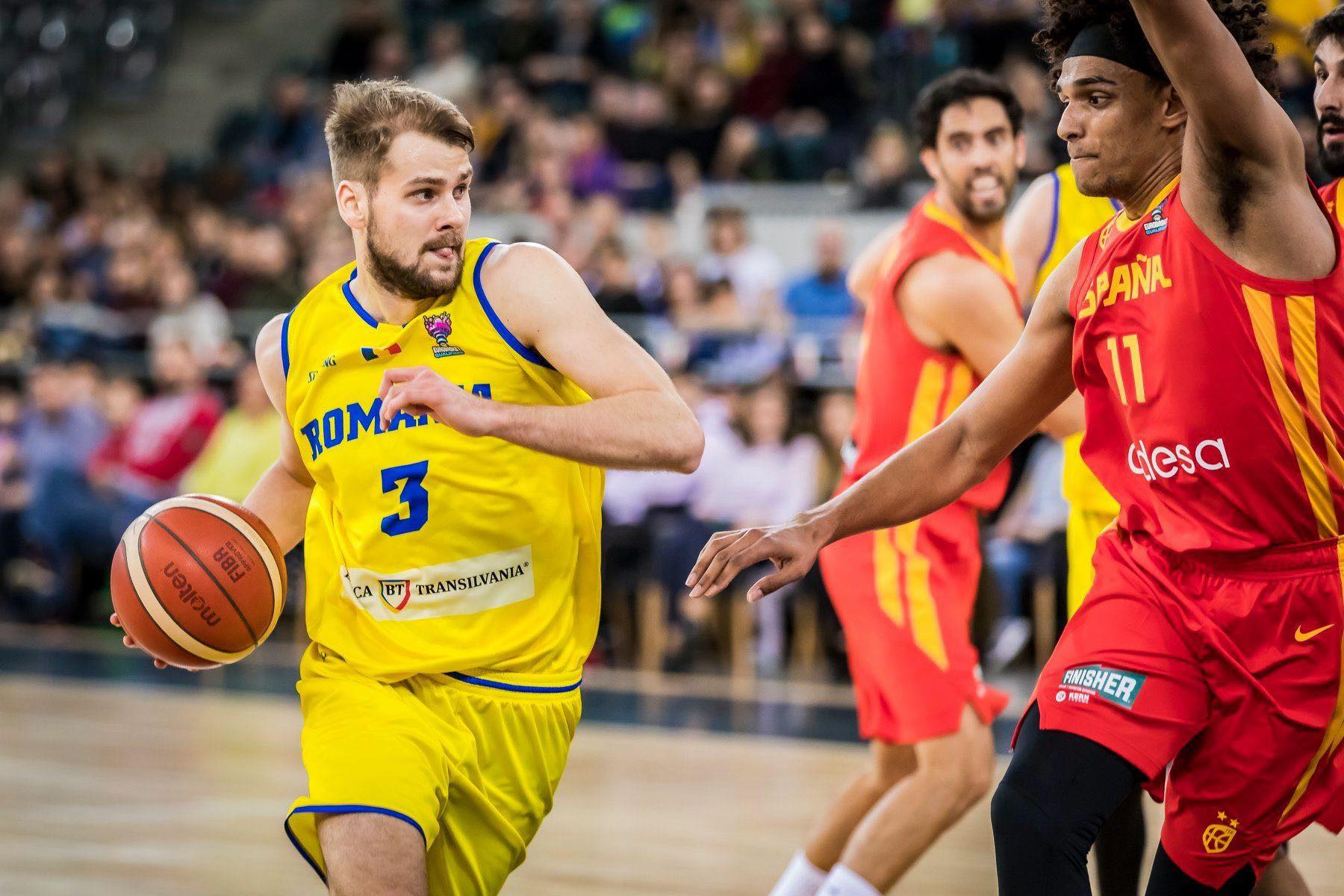
Dragos Diculescu (196-G/F-1999, agency: One Motive Sports) is a 27 year old 196cm guard from Romania playing his second season in Germany and first with Pro A club EPG Baskets Koblenz. He played his first season in Germany in 2024-2025 with the BG Hessing Leitershofen (Germany-Pro B) averaging 18.8ppg, 5.8rpg, 4.5apg, 1.5spg, FGP: 63.1%, 3PT: 35.3%, FT: 74.1%. Last season he palyed with the Koping Stars (Sweden-Basketligan) averaging 16.1ppg, 5.7rpg, 4.1apg, FGP: 52.7%, 3PT: 34.2%, FT: 87.4%. He began his basketball career in his native Romania and palyed with teams like Steaua CSM EximBank Bucuresti (Liga Nationala), BC Timisoara (Liga Nationala), and SCM CSU Craiova (Liga Nationala. He then played 2 seasons with Landstede Basketbal Zwolle (Holland-DBL). He spoke to germanhoops.com about basketball.
Thanks Dragos for talking to germanhoops.com. Congrats on signing with the EPG Baskets Koblenz. After a season in Sweden, your back in Germany. What kind of a relationship did you personally get when you played in Leitershofen 2 seasons ago?
First of all, I’d like to thank you for the opportunity to do this interview. I’m grateful for the platform to share my thoughts, my mentality, and a little bit more about who I am as a player and person. As for returning to Germany, it was a decision that felt very natural to me. I had a great experience here before, and I’ve always viewed German basketball as one of the strongest and most professional environments in Europe. The level of organization, the quality of the competition, and the opportunities for player development make it a great place to grow. I have ambitious goals for my career, and I believe Germany is a country where strong performances are recognized and where players can continue taking the next steps in their development. At the same time, it’s simply a great place to live and work as a professional athlete. When the opportunity to return came up, I was genuinely excited because I felt it aligned with both my personal and professional goals.
You reached the final in Holland some years ago and are still looking for your first pro title. The EPG Baskets are surely a team that won´t win the title. Why did you chose to join the EPG Baskets Koblenz?
Winning a championship is definitely one of my career goals, but I’ve always believed that championships are the result of a much bigger process. My focus is on becoming the type of player who can consistently contribute to winning at the highest level. In basketball, the margins are incredibly small, and there are many great players who have had championship-level careers without necessarily winning a title every season. My goal is to keep developing into a championship-caliber player, and I trust that success will follow. As for Koblenz, I never choose a team with the mindset of limiting what is possible. Every team I’ve joined, I’ve joined with the intention of competing and winning. Of course, there are teams with bigger budgets or different expectations, but budgets don’t play the gamesplayers do. First, we have to focus on building something strong and reaching the playoffs. Once you’re there, anything can happen. More importantly, I felt that Koblenz was the right environment for me to continue growing as a player and as a person. I had a great feeling from the conversations with the club and the coaching staff, and when you find a place that aligns with your goals and values, there is no reason to keep looking elsewhere.
How did the talks go with head coach Stephan Doehrn. What did you appreciate right away about his basketball philosophy?
I really enjoyed my conversations with Coach Stefan. We had discussions last year as well about a potential collaboration, and even then I got the impression that he views basketball in a very modern and professional way. What stood out to me was his vision for building a team and the principles he wants that team to be built on. It felt like a healthy environment with a clear identity, which immediately appealed to me. I also felt that the role he described was a very good fit for my strengths as a player. More than anything, I’m excited for the opportunity to learn from him and better understand his perspective on the game. There’s definitely a lot of curiosity and enthusiasm on my side, and I’m looking forward to working together.
How excited are you to be teammates with Ferenc Gille again? What do you appreciate most about his game?
Ferenc and I built a strong connection the first time we played together because we shared a similar view of the game and a genuine desire to keep improving. We both had a growth mindset, spent a lot of time talking basketball, and I really enjoyed seeing how our chemistry developed throughout the season. What I appreciate most about him is his consistency, energy, and team-first mentality. He’s one of the most reliable teammates I’ve played withsomeone who brings experience, professionalism, and always puts the team’s success ahead of individual recognition. I’m really excited to share the court with him again. We created a lot of great memories together the first time around, and I’m looking forward to building on that in the season ahead.
The club sees you as being one of the leaders on the team. How do you feel comfortable of having that type of responsibility in your first Pro A season in Germany?
I’ve always been a vocal, high-energy player, and I’ve been fortunate to take on leadership responsibilities throughout different stages of my career. Because of that, leadership is something that feels natural to me, and I’m excited about the expectations and responsibility that come with this opportunity. At the same time, I believe successful teams have multiple leaders. Leadership isn’t carried by one person aloneit’s shared among players, coaches, and people throughout the organization. Personally, I’ve never been afraid of responsibility. Every season and every challenge brings lessons that help you grow, whether things go well or not. That’s why I approach this role with excitement rather than anxiety, and I’m looking forward to contributing both on and off the court.
Let´s talk about your game. You’re a 196cm swing man. If you had to compare your game to a Euroleague player, who would best fit the description?
The most natural comparison would probably be Marko Guduric because we’re both left-handed and share some similarities in the way we see the game, especially in terms of playmaking and versatility. At the same time, I’ve never tried to model my game after just one player. Throughout my career, I’ve studied a lot of EuroLeague players and tried to take small elements from each of them. Some things fit naturally, some don’t, and that’s part of the process. For me, it’s never about copying someone else’s gameit’s about learning from the best and using basketball as a constant library of ideas. Those lessons can come from EuroLeague stars, former players, teammates, or even younger players. I’m always looking for ways to improve, but ultimately the goal is to build a style that is authentic to who I am as a player.
You’re a very versatile player and also have a very high IQ. You were close to a triple double last season in Sweden against BC Lulea. How valuable are these qualities in your game?
I believe versatility and basketball IQ are two of the foundations of my game because they allow me to impact winning in different ways. Every game is different, and my goal is always to give the team what it needs most. Some nights that means creating for teammates and making the right reads, other nights it means scoring, rebounding, or taking on tough defensive assignments.
I’ve never viewed basketball only through points or statistics. For me, it’s about helping the team win, whatever that requires. That’s why I’m constantly working on every aspect of my game, trying to become as complete and reliable a player as possible for any team I represented.
Early in your career you shot 50% from outside with BC Timisoaraand a few years ago in limited action 45% with CSM Constanta. How do you rate the development of your three pointer? How big of a goal is it reaching that 40% plateau?
I think percentages can be a useful reference, but they can also be misleading if taken out of context. Shooting numbers are always influenced by things like shot volume, role, and shot selection, so it’s important to understand the situation behind them rather than just the final number. For me, the focus is less on hitting a specific percentage threshold and more on the quality of my decision-making. As my role changes and I take on more responsibility, the number and difficulty of shots can also change, which naturally affects efficiency. What I try to control is taking the right shots within the flow of the game and making good decisions on when to shoot, when to pass, and how to create the best outcome for the team. I trust the work I put in and my ability as a shooter, so I focus more on maintaining high-quality shot selection and consistency rather than chasing a specific percentage.
Talk about your defensive game. Where would you rate yourself as a defender right now and what kind of a defender do you still want to become?
I think defense is often viewed too much through an individual lens, when in reality it’s one of the most collective aspects of basketball. Over the years, playing in different countries and systems has helped me develop a better understanding of team defense, communication, rotations, and the importance of being connected as a unit. As a defender, I try to bring consistency, communication, and a strong understanding of the system. I take pride in being vocal, knowing my responsibilities, and helping teammates be in the right positions. At the professional level, effort and discipline are just as important as physical tools. Of course, like every part of my game, there is always room for improvement. That’s why I spend time studying film, analyzing mistakes, and looking for ways to become more effective. My goal is the same as it has always been: to be a player who contributes to winning, and defense is a big part of that.
On what areas of your game will you work on most this summer so you can continue to improve as a player?
In the summer, I think it’s important not to try to improve everything at once, because that usually leads to losing focus. Instead, I try to identify a few key areas and really commit to them. For the first time, I also know quite early what my situation and role might look like for the next season, which helps a lot in structuring my work. At the same time, I’m in ongoing conversations with the coaching staff, because I don’t just want to work on what I personally feel I need, but also on what the team will need from me. So my approach is to combine both perspectives: my own development priorities and the system I’m going into. I try to understand early how I will be used, and then prepare specifically for that role so I can arrive already adapted and ready to contribute from day one.
Thanks Dragons for the chat.

