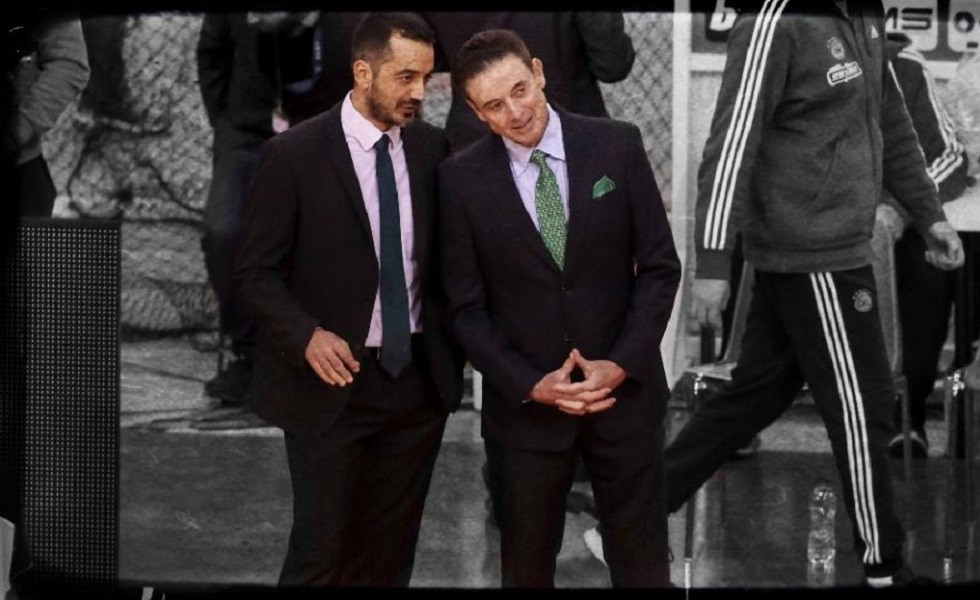
Giorgos Vovoras (agency: Octagon Europe ) is a Greek coach that currently is the coach of the Bahrain national team and a consultant for Bahrain at the 2026 Albert Schweitzer tournament. He has had experience coaching in Greece, Hungary, Lithuania and Cyprus. He gained his most success winning 10 titles with Panathinaikos as an assistant coach. He spoke to germanhoops.com before the game against Germany at the Albert Schweizer tournament in Mannheim.
Thanks Giorgos for talking to germanhoops.com. You hail from Greece and have coached many clubs in Europe as well as Euroleague team Panathinaikos. Now your coaching the Bahrain national team and are a consultant at the U-18 championships at the Albert Schweitzer tournament in Mannheim Germany. This was a different kind of challenge for you. Why did you take this on?
Since June 2025, I have been working in collaboration with the Bahrain national team as the head coach of the senior national team, as well as a consultant for the overall development program of Bahrain basketball. What really motivated me to take on this role was the vision of the federation. I saw a federation that is making a new and ambitious effort, with clear goals and big dreams for the future of basketball in the country. It is a different challenge for me compared to my previous experience in Europe, but at the same time, it is very motivating to be part of something that is being built in a proper and sustainable way. Already, we have seen positive signs. Last year, the U16 national team made important progress, finishing 7th in the Asian tournament, which shows that the program is moving in the right direction and the Bahrain national team also finished in third place at the William Jones Tournament, which is the best result ever achieved by a Gulf country. In addition, we had a very strong performance in the Arab Tournament.
Bahrain is in Asia and not known for it´s basketball. They have a league where ex NBA players play and where there is money. However how much interest is there in basketball in that country?
Basketball in Bahrain is actually considered the national sport, and there is a strong love and passion for the game across the country. From my personal experience, having attended the league finals last year, the arenas were full, and the atmosphere was intense, with great energy and passion for winning. As I mentioned before, there is a serious effort being made to take important steps forward, especially at the national team level, with the goal of establishing Bahrain as a more competitive and respected presence in Asian basketball.
How is the state of youth basketball there? This is Bahrain´s first time playing at AST. Is it a sport that is growing?
The Albert Schweitzer Tournament in Mannheim is one of the most prestigious and historic international U18 tournaments, with a long tradition, where many top talents from around the world have competed over the years. For us, participating in this tournament is a very important opportunity to compete at a high level and provide valuable experience to our young players. For us, participating in this tournament is even more important, especially given the current circumstances in the region and the postponement of the Gulf U18 Tournament. The federation recognized this as a valuable opportunity for our players to gain experience at a high-level and globally respected event. Regarding youth basketball in Bahrain, as I mentioned earlier, there is a structured effort to build the development model step by step, with a strong focus on the new generation. We have had the opportunity to include several talented players in the program, who are already showing great progress. At the same time, significant emphasis has been placed on developing competitive leagues at the U16, U18, and U20 levels within Bahrain, which clearly reflects the serious work being done across all age groups.
Please talk about some of the talented players. What players can we look for during the AST?
We have two players with exceptional talent and great potential, Hassan Abdulkhadir and Somto Patrick. At the moment, they are studying and playing in highly competitive high school programs in the United States. I had the opportunity to visit them in February and closely observe their development and the way they are working within these environments. They are part of very strong and demanding programs, and they have already received scholarship offers from top Division I colleges. They also had an excellent performance in last summer’s Asian tournament, which further highlighted their potential. This gives us great confidence and excitement for the future, as we believe they can play an important role in the next generation of Bahrain basketball
Germany has had massive success in men´s basketball the last years winning the World Cup and Euro. They also have had great results at the youth sector. How have you followed the development of the basketball there?
Germany’s recent success in men’s basketball is not something that happened overnight. It is the result of a long-term process that started many years ago, even after the generation led by Dirk Nowitzki, when Germany was already competing at the highest level. In the years that followed, the federation made a clear and strategic investment in youth development. They focused on building a strong development structure, improving coaching education, and creating competitive environments for young players. I believe this has been the key factor behind their current success. Today, Germany has players performing at the highest level, from the NBA to the EuroLeague and top domestic leagues across Europe. This clearly reflects the quality and consistency of the work that has been done over the years. For me, Germany is a great example for other federations. Their model shows how important it is to invest in youth development with a clear plan, patience, and continuity, in order to achieve long-term success.
What do you believe is the secret to Germany´s success in the last years? Is it more than just discipline?
It’s not just discipline. Talent is always present, but the key is the process and consistency. Germany trusted their system, stayed patient, and followed a clear long-term plan — and that’s what led to their success
How tough a game can you await? Is Bahrain the massive underdog or just underdog against Germany?
For Bahrain, this will be our first game against a European team, which makes it a very valuable experience. We expect a tough and physical game against one of the top teams in Europe. However, we believe in our identity and our style of play, and our goal is to compete and challenge ourselves at the highest.
Is there a German player that you feel could be the big attraction at AST?
Germany always brings a very talented group to this tournament, so it’s not about one specific player. Their strength is the overall level of the team — athleticism, discipline, and strong fundamentals. That’s what makes them so competitive year after year.
You have been a coach in Cyprus, Lithuania, Russia and Greece. Talk a little about what kind of a coach you are?
Throughout my career, I have had the opportunity to work with top coaches and players at the highest level. These experiences have helped me build my own coaching philosophy. I would describe myself as a coach who tries to adapt to modern basketball. I believe in building teams that are disciplined with defensive mentality, play with intensity at a high pace and understand the game. For me, it’s not only about tactics, but also about creating the right mindset, where players compete, improve every day, and play for each other
You were an assistant coach for many years with Euroleague powerhouse Panathinaikos and won 10 titles. Which title was your favorite?
During my years with Panathinaikos, we won many titles, but there are two that stand out for me, and it’s difficult to choose between them. The first one is the 2012–2013 season, with coach Argyris Pedoulakis. It was the first year after the end of a great era for the club, with a new team built around key Greek players like Dimitris Diamantidis and Kostas Tsartsaris. Despite the challenges and having home-court disadvantage, we managed to win the finals against the reigning EuroLeague champions Olympiacos with a 3–0 series, which made that season truly special. The second title I highlight is the 2016–2017 season, under coach Xavi Pascual. We won the championship against Olympiacos with a 3–2 series, with the decisive Game 5 played away from home. It was a very competitive series, with players like Nick Calathes and Mike James playing key roles. What I will never forget is our return home, where around 30,000 fans were waiting for us to celebrate this title together
What was it like working under legend Rick Pitino. What could you learn from him and what was your coolest story?
It was truly a unique experience to work with a coach like Rick Pitino, who has achieved everything in college basketball and also had a great career in the NBA. What impressed me the most was his passion and love for the game. Every single day, he found motivation not only for himself but also for his players, and he worked with incredible energy and passion in every practice, always driven by the desire to win. For me, every day working with him was an opportunity to learn. The most important thing I took from him is that basketball is not only about tactics. The mental aspect of the game — how you prepare players psychologically for every practice and every game — is equally important. He puts a huge emphasis on this area, and for me, working with him was a great learning experience There are many stories I could share, because he always found ways to inspire the team. But one moment I will never forget was when we learned about the passing of Kobe Bryant. The next day, we had an important league game. Coach Pitino came into the locker room and didn’t talk about the game at all. Instead, he gave an incredible speech about who Kobe was as a person, as a family man, and as an athlete. It was a very emotional moment — almost everyone was deeply moved. When we left the locker room, I asked him how the players would be able to focus after that. He told me, ‘Don’t worry, just watch the first minutes of the game.’ And he was right — we started the game with incredible intensity and focus. For me, this shows how important it is to impact players mentally and emotionally, not just tactically.
You coached so many great players at Panathinaikos. Please name your 3 favorite players?
I’ve been fortunate throughout my career to work with many great players and, more importantly, great people. It’s always difficult to choose, but when you have had the opportunity to work with players like Dimitris Diamantidis, the greatest players in EuroLeague history, Mike James, the all-time leading scorer of the EuroLeague, and Nick Calathes, one of the best passers in the competition, I think the answer speaks for itself. What they have achieved, both individually and with their teams, reflects their quality and consistency at the highest level.
Please name your coaching Mount Rushmore (4 greatest coaches for you)?
If I had to choose my coaching Mount Rushmore, I would say Xavi Pascual, Rick Pitino, Željko Obradovic, and Saras Jasikevicius. Xavi Pascual is one of the best tactical coaches in EuroLeague, and working with him helped me organize my thinking and understand how to prepare a game at the highest level. Rick Pitino taught me that basketball is not only about tactics, but also about the mental aspect and how to motivate players every day. Željko Obradovic is, in my opinion, the greatest European coach, having created his own basketball culture and philosophy over many years. Sarunas Jasikevicius is a coach I have followed closely for many years. What stands out is his ability to adapt, to develop his teams in different environments, and to build a clear playing identity based on modern basketball principles.
Thanks Giorgos for the chat.
 German Hoops