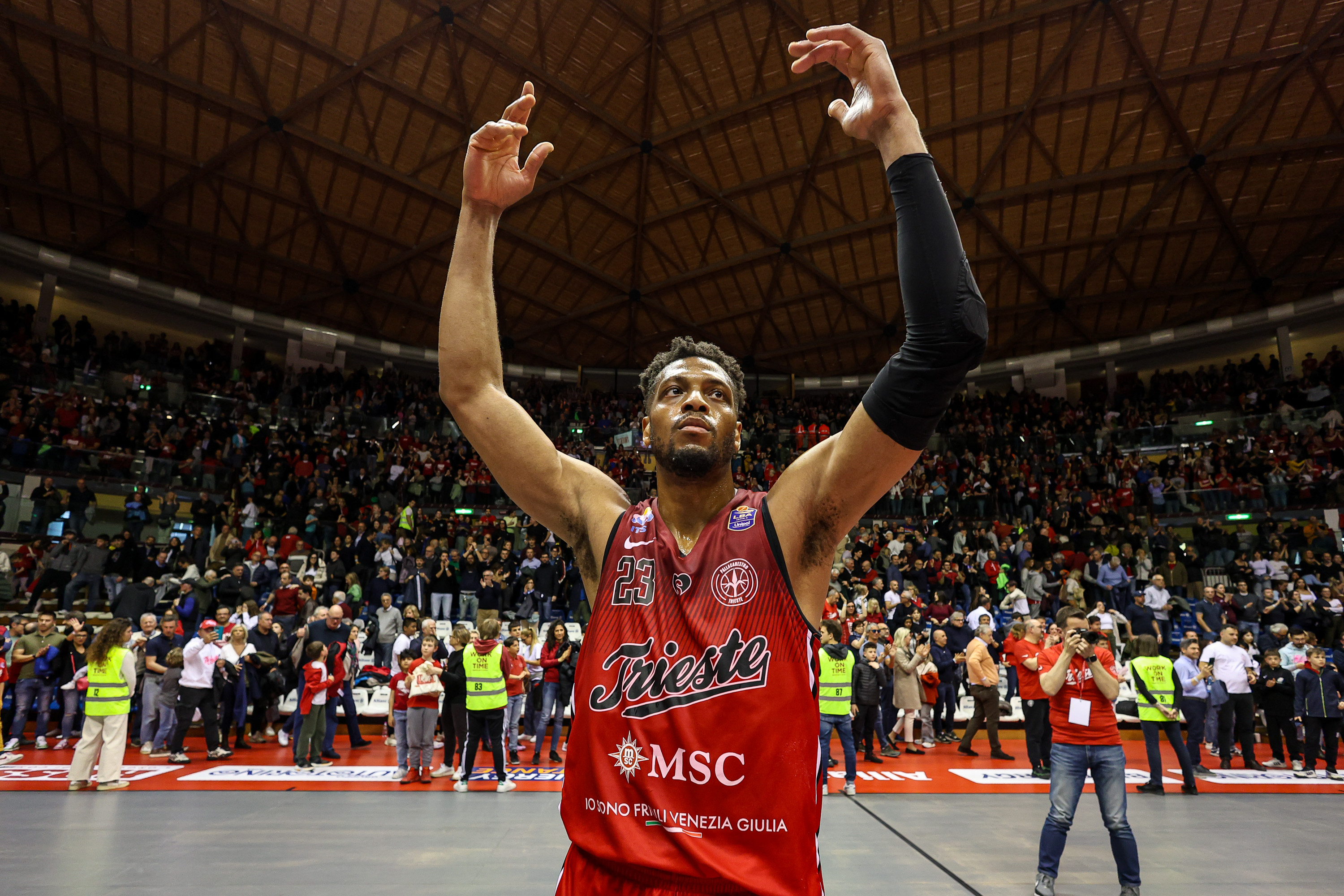
Jeffrey Brooks (203-PF-1989, college: Penn State) is a 36 year old 203cm forward from Louisville, Kentucky playing his 15th professional season and second with Pallacanestro Trieste (Italy-Serie A). He has played most of his pro career in Italy with seasons, but also played in Russsia and Spain. He began his basketball career at Doss high school and then played at The Pennsylvania State University (NCAA) from 2007-2011.He has played 105 Euroleague games and played more than 300 Serie A games. He spoke to germanhoops.com before a Basketball Champions League game against German team Wurzburg.
Thanks Jeffrey for talking to germanhoops.com. Your playing your 15th professional season and just keep going. Was there a deciding moment in your career that helped you carve out such a long career?
That’s a funny question. I guess when I started, because you have to start somewhere, you know? I started 15 years ago, like you just said, and I don’t plan on stopping anytime soon. I really enjoy the game, and I think that’s the most important part—that you enjoy what you do. The more you enjoy it, the easier it becomes to keep doing whatever you’re doing.
This is your 12th season in Italy. What has been so appealing to you that has always brought you back to Italy? You are now with your 7th team.
Well, I’m going to bring her up a lot—being married to a woman from Italy has definitely helped me want to stay here. It’s home for me now in a sense, because her family is here, and now they’re my family too. Our son is being raised here, this is half of his culture. So having the opportunity to continue playing in Italy is really important for my family and for how our son grows up. Every city I’ve played in here, every team I’ve played for, I’ve enjoyed. And it’s always helped me keep growing as a player and also as a person.
You are also a very special player in that you were never an explosive scorer, but a guy that helped pro teams win 7 titles. What is the speciality of your game that has allowed you to have such a long career?
I think my specialty as a player is that I can play anywhere on the floor at any time. It’s kind of weird even bringing up the idea of being an “explosive scorer” in Europe because of how the game is played here. One game you can score 25 points and the next game you only have 5, because the defense keys in on you not shooting the ball. And if you’re playing on winning teams, you don’t just go out there to shoot. So honestly, I don’t really understand that term over here. Our game is more about everybody on the floor being efficient and effective. And I think that’s what I’ve been able to do for most of my career. As long as I can keep doing that and stay healthy, I think I can play for a long time.
What is so special about the Pallacanestro Trieste (Italy-Serie A) organization? Could you imagine finishing your career here?
What’s special about this place is how important basketball is, not just for the organization but for the whole city. Everyone here gravitates toward the game—the older people, middle-aged people, people my age in their 30s, down to the kids. Everybody here loves it. Honestly, I’ve never been in another Italian city where the whole city is so fascinated and obsessed with basketball. As for finishing my career, I really don’t know where that’s going to be. It could be here. If I’m playing another 7 or 8 years, I’d be perfectly fine with that. If God blesses me to be in one place that long again, and our son can grow up here, that would be a great situation. But I really don’t know. The main thing is that I’m still playing the game. Trieste has given me the opportunity to keep playing, and I’m just going to keep running with it as long as I can.
You played 3 seasons with Umana Reyer Venezia (Italy-Serie A). What was so special about this time? There aren’t many Americans in the world that can say that they lived 3 years in Venice.
Uh I don’t know… I think what was special about my time there was mostly off the floor, honestly. That was when our son started to grow up a little more—you could see him walking, talking, really being more aware of what was going on. He started to understand that he was moving to a new place, from Milan to Venice, and he was noticing the change. Of course, we didn’t live on the islands—we were in Mestre. That’s something people often get wrong: when you play for Umana Reyer Venezia, you usually live in Mestre, not Venice itself. But Venice is always worth it—the architecture, the history, such a unique city. There’s only one Venice in the world. Seeing the canals, people having to walk everywhere, the gondolas—it was just such a cool place. On the court, I had the chance to play under two coaches, Walter De Raffaele and Neven Spahija, and I was able to learn two different styles of basketball. That helped me grow as well. So it was definitely a worthwhile experience.
The home court is on the main land, but how do you remember the city on the water? What was your favorite place to visit there?
For me, there was a restaurant called Osteria Osottoosopra. Man, the food there was so, so good. The risotto, the pastas, the wines—it was just amazing. If anyone reading this interview goes to Venice, you should definitely check it out. Osottoosopra is a wonderful restaurant.
You played 3 seasons with AX Emporio Exchange Milano (Italy-Serie A) playing 80 Euroleague games. What was it like playing for legend Ettore Messina? What was the most important thing that you learned from him on the court?
Playing for Messina is demanding. He’s a man who wants to win. He wants his team to win, and he wants everybody to put everything into that idea of winning. That’s it—whatever you can do to help us win, that’s what he wants. So, what I really learned was how to be effective without thinking about scoring 15 points a game or things like that. How can I help my team win? If that means rebounding the ball, guarding the best player on the other team and making sure he has a tough night, hitting a shot to put us up late in the fourth quarter—whatever the case may be—just make a play to help the team. That’s something I try to remind myself of every year: to learn something new to keep adding to my repertoire. Not only for myself, but also so I can teach it to Jordan, our son. What I took from Messina is how demanding he is for excellence. It’s not easy for everyone to play in that type of environment, and being able to do it for three years—well, two years with Messina—was definitely something I can share with my son. I can tell him: every day you step on the floor, demand excellence—not just being good, but excellence. Some days you might fall short, but even if you fall short, you’re still reaching greatness instead of settling. That’s one of the biggest lessons I learned from playing for Messina.
You were teammates with legend Kyle Hines. What will you always remember from him? What was most enticing his work ethic or killer mentality?
I don’t really like to talk about “work ethic” with guys at this level, because everybody works hard—we just go about it in different ways. And “killer mentality” usually gets thrown around in terms of scoring. What I think really defines Kyle Hines is excellence. He brought it on both ends of the floor—his leadership, his ability to guard positions one through five, his ability to drive from the perimeter, make the right pass in the short roll. He was such an excellent player, and I never saw him take a day off from being there for his team. He always knew when to make a play, when to say something—and he’s a man of few words. For me, he’s the greatest American player ever to play in Europe. I don’t want to argue about it—I just believe Kyle Hines is the greatest American to ever play here.
You played 2 seasons with Unicaja Malaga (Spain-Liga ACB) winning the Eurocup in 2017. What was so special about that team that season? You had 2 incredible guards with Kyle Fogg and Jamar Smith.
I think it was the togetherness of that team. Even in my second season, it was the same. We weren’t the biggest team, we weren’t the most talented team, but the chemistry, the connection, the understanding we had of each other—that’s what led us to the EuroCup. Nobody picked us as favorites, not by any stretch of the imagination, but we found a way to get it done. I think it was one of the best teams I’ve ever been on, just because of how connected we were. We knew each other like the back of our hands. And it’s funny, because that group was mostly new—some guys had been there before, but most of us were new—and we figured it out pretty quickly. It was a hell of a team, and that’s definitely one I’ll never forget.
You played 5 times against Real Madrid in the 2016-2017 season winning the first 3 games and game 1, but losing game 2 and 3 and your ACB season ended. You played against Luka Doncic 5 times. What will you always remember from his game? Would you have ever thought that he would go on to be one of the best players in the NBA?
It’s funny, because I was actually debating with an NBA scout about that draft. He was saying, “No, you have to take DeAndre Ayton, you have to take him.” And literally the night we played Real Madrid, after the game, I told him, “There’s no way in hell you don’t take Luka Doncic first.” He said, “But they already have Devin Booker.” I told him, “Okay, but you’ll figure it out.” The way Luka was playing at that age in the ACB and EuroLeague was so impressive—not just his skill, but how he was taking his time, reading the game, being fearless, and doing it all at such a young age, with a smile on his face. He was really enjoying himself. Now, when he went to the NBA, because of the athleticism gap, the expectations of being a top-three pick, all that, I didn’t see Luka Magic coming so fast. I thought maybe it would happen later. But after those first two seasons, seeing how easy he made it look, I was like, damn—I wasn’t expecting that. And the guy just keeps doing what he needs to do to be who he is. Like slimming down this year—people said he didn’t look in the best shape, but he was still putting up 27, 28 points a game. I expect him to keep being great, because he’s really, really, really good.
You also played a season in Russia with Avtodor Saratov (Russia-VTB United League) averaging 11.0ppg, 5.8rpg, 2.2apg, 1.2spg, FGP: 56.0%, 3PT: 41.9%, FT: 78.5%; and in the Eurocup: averaged 13.1ppg, 8.2rpg, 2.4apg, 1.2spg, FGP: 59.6%, 3PT: 38.5%, FT: 89.6%. What kind of an experience was Russia for you? What was your fondest moment there on and off the court?
I think my fondest memories there were really about the battles. Playing in the VTB was such a physical league, and it felt like the referees sometimes even encouraged the physicality more than focusing on the game itself. My wife used to tell me I came out of games with bruises and blood, and I’d just say, “Well, that’s the game here.”. One of my biggest rivals there was Janis Timma — he played for Zenit. Every time we faced each other, it was a battle. Neither of us ever fouled out or got ejected, but the physicality and the competitive drive were unforgettable. I really respected him, and if I’m not mistaken, he passed away last year. On the basketball side, that was another place where I learned to just figure it out wherever I was on the floor. In Russia I played the three—off the ball, posting up, sometimes running pick-and-roll. It didn’t matter. As long as I was in the game, I’d figure it out and make plays for our team to win. Off the court, that’s where our son was conceived. It was my first year being married, and we spent so much time together—getting to know each other better, learning more about what we like and don’t like. That year in Russia really kicked off the 10 years we’ve now been together as a married couple.
You also played a season with Banco di Sardegna Sassari (Italy-Serie A) averaging 9.0ppg, 6.5rpg, 1.2apg, 1.1spg, FGP: 56.9%, 3PT: 36.8%, FT: 78.0%; and in the Euroleague) averaged 9.3ppg, 5.0rpg, 1.3apg, 2.0spg, FGP: 55.6%, 3PT: 47.1%, FT: 76.9%. You helped the team win the Serie A title. What was so special about that team?
That team was full of unpredictability. And what I mean is, you never knew who was going to go off that night because we had so much talent. You had David Logan, Jerome Dyson, Edgar Sosa coming off the bench, Rakim Sanders, Shane Lawal, Kenny Kadji, Matteo Formenti—we just had so many guys who could make plays. You didn’t know who was going to be the star that night, but you knew everybody was going to contribute. That was definitely the hungriest, most athletic team I’ve ever played on. There was no drop-off anywhere. There was nobody you could attack on defense, and offensively everybody was fast and explosive. So really, it was pick your poison. That’s why I think that team is the last one to win the “triplete” in Italy. It was such a forceful group. Anytime we had to win a big game—Game 7 of the finals, the SuperCup, the semifinal to get to the Italian Cup Final—we did what we needed to do. It was a hell of a team. Meo Sacchetti was the coach, and he kept us running all game: move the ball, make plays, defend, run fast.
You also played a season with Pasta Reggia JuveCaserta (Italy-Serie A) averaging 14.4ppg, 6.3rpg, 1.5apg, 1.6spg, FGP: 56.7%, 3PT: 45.2%, FT: 77.0%
That year I played with a bunch of young guys. I was young too—that was young Jeff. Marco Mordente was our captain and Lele Molin was the coach. That was actually one of the first seasons where I learned how to be a leader. We had a lot of guys coming straight from college in America, trying to adjust to playing in Italy. And I was called on to take more of a leadership role—not as captain, but as someone who had already been here a couple of years and played EuroLeague. I had to help guys learn the style of play, the physicality, even off-the-court stuff like where to eat, where to go. We had a really good year. We brought in Ronald Moore in the second half of the season, and honestly, if we had had him from the beginning, I think we would’ve been a top-five team. In those last 15 games, we were really good—we just couldn’t figure it out in the first 15. And you know, when you dig yourself a hole, sometimes it’s hard to get out.
In the summer of 2013 you played NBA Summer League with Utah and Houston and in 2012 with Washington. What memories do you have of those times? It was a long time ago where the NBA was different than it is today. You were teammates with rookie Bradley Beal. What was the coolest moment you had in Las Vegas?
Vegas was cool. In my opinion, it’s more of a show now, but back then it was really about trying to earn a spot in the NBA. Now it’s more about promoting the game globally. I had a really good run in Summer League. Things just didn’t pan out. I played with a team that already had like six guys under contract, and it was tough to break through. The next year, honestly, I wasn’t in the best mental shape. I wasn’t focused on basketball—I was thinking more about things happening in my personal life and my family. And it showed. I didn’t perform particularly well. But that’s fine, because it was a learning experience. What I realized is that the gap between players here in Europe and players there isn’t as big as people think. It’s about opportunity, and taking advantage of it. And when you don’t, you fall short. Me falling short meant I’ve been in Europe for 15 years—and I’m not mad about that at all. If my life had gone differently, I wouldn’t have met my wife, I wouldn’t have my son. So it is what it is. I’m happy I had that experience, because it’s something I can share with Jordan. I can tell him: when you’re given an opportunity, do everything you can to succeed in it.
In the 2012-2013 season you played with FoxTown Cantu (Italy-Serie A) averaging 7.8ppg, 4.8rpg, FGP: 54.4%, 3PT: 32.7%, FT: 77.1%; and in the Euroleague avergaed 8.3ppg, 4.9rpg, 1.3apg, FGP: 61.4%, 3PT: 10.0%, FT: 55.6%. You played for young up and coming head coach Andrea Trinchieri and got your first dose in the Euroleague. You played against countless legends from Madrid and Panathinaikos. What Euroleague player do you remember having a big impact on you?
That’s a good question—so many players to choose from. But honestly, I’m going to stick with one of my own teammates, Manu Markoishvili. He was with us for part of the year before leaving mid-season for Galatasaray. He was my wake-up call to just how good European players really were, because I had to guard him every day in practice. And he was kicking my ass every single day. I was playing the three, so I had him as my matchup. This guy could score from anywhere. He was athletic, but also four inches shorter than me, and I kept thinking: “How is he getting his shot off? How is he finding his spots?” He was so polished. That experience really helped me defensively. If I could get a couple of stops on him, then I knew I could guard anyone in the league. That’s how good he was. Hell of a player.
You played your rookie season with Fileni BPA Jesi (Italy-Lega 2) averaging 17.0ppg, 6.9rpg, 1.7spg, FGP: 61.9%, 3PT: 41.0%, FT: 77.4%. What do you remember being your wake up call to being a rookie where you knew that you were far away from home?
I mean, that’s just an easy question. Honestly, just stepping off the plane. Once you land and you’re on your own, it hits you. There’s no mom, no dad, no brothers or friends, no teammates you’ve spent four years with in college—you’re just by yourself. That was the wake-up call. The first month and a half was tough. I struggled with the change of environment, the language, the food, the time difference—everything was different. But my coach, Stefano Cioppi, told some of my teammates: “Take Jeff out to dinner, get him out of his apartment, make him feel like he’s part of the group.” And they did. That night changed everything for me. I felt like my teammates wanted me to be a part of the family, not just for the team but for myself too. From there, things got better. I had a really good season, and we had a strong year as a group. And I always say this: Jesi is the best city in Italy. That’s the mecca. That’s where it all started for me.
You played at Penn State´ (NCAA) from 2007-2011 and reached March madness in 2011 losing to Temple. You made big strides as a senior averaging 13.1ppg, 6.3rpg, 1.7apg, 1.4bpg, FGP: 54.7%, 3PT: 40.3%, FT: 74.4%. How did your game grow there?
I think my maturity grew more than anything. Growing up, I didn’t understand much about life outside of basketball. The game was my escape from a place where there was a lot of despair and hopelessness. When I got the chance to play Division I basketball, I didn’t go into it thinking about the NBA or a future career. Some guys do, but I didn’t. I just thought: “Man, I’m away from home, I’m enjoying this.” I wasn’t serious enough. My first two years were tough. By my third year, I started to figure it out, and in my senior year, I really exploded. I had confidence from my teammates, from the work I put in at the gym, and from just enjoying the game more. At the same time, I knew it was coming to an end—it was my last year—so I gave it everything. If I had gone into college with a different mindset, maybe I would’ve had four seasons like my senior year. But that’s life—you learn through experience. I had a great four years at Penn State. I’m proud I chose that school, proud to have graduated in August 2011, and I’ll always look back at it as a great chapter in my life.
How did head coach Ed DeChellis groom and prepare you for a professional career?
I think more than anything, he understood that I was talented—but it was my maturity he had to work on. Maturity and confidence. He kept telling me how good of a player I could be if I really believed it, if I understood my potential. That meant not just taking the game seriously, but being brave, competing, and actually wanting to be good, wanting to help my team. The more I started to understand those things, the better I got. And Coach DeChellis never let me off the hook—he stayed on my ass all the time. He recruited me heavily out of high school, and when I got to Penn State, he made sure I was doing what I needed to do both on and off the court. He wanted me to be the best player I could be, but also the best student-athlete I could be. I hold Coach DeChellis in very high regard because without him, I wouldn’t be here. He’s a huge reason why I am the man I am today.
Who won a 1-1 in practice you or DJ Jackson?
Funny enough, DJ and I didn’t match up that often because I played the three and he played the four, so most of the time we were actually on the same team. When we did play one-on-one, sometimes he got me, sometimes I got him—it went both ways. But the guy who really gave me the toughest battles was Jermaine Marshall. He actually played in Europe for a while before tragically passing away in France about three years ago from an undiagnosed heart condition. Jermaine and I played one-on-one all the time, and honestly, he beat me more than I beat him. If we played ten games, he probably won six and I won four. He was a two-guard, so guarding him was tough—he was quick, could really score, and he pushed me defensively. But those battles made me a better defender and competitor.
Who was the toughest player that you ever faced in the NCAA that reached the NBA?
There were a lot, but the one I remember most is Draymond Green. I played against him his first two years at Michigan State. What stood out wasn’t just his talent—it was his fire. Even as a young player, he brought so much energy, always finding ways to push his teammates to another level. Michigan State is always strong, but Draymond’s intensity made them even tougher. He was undersized, but man, he was a force. Another guy people might not talk about as much is Jon Leuer. He played at Wisconsin and later for the Detroit Pistons. He was 6’11”, could play inside and outside, shoot the three, handle the ball like a guard—just a really tough matchup. I loved competing against him, though, because every time it was a challenge. And I always liked challenges.
Please name your five best teammates of all time.
Uh… okay, so many guards, so many players. Alright, let me go by position. Point guard, I’d go with Mike James. At the two, I really like Markel Brown. I like him because he plays both ends, knows how to come off floppies, plays downhill, defends, and can slash I’m also going with David Logan, because when you talk about killer mentality, that’s him. He’s a sniper, but he also plays defense—he guards guys the full 94 feet. He’s such a professional three-man. At the three, I’d say Shavon Shields, and also Rakim Sanders. Shavon is smooth, especially off his right hand, really nice in pick-and-rolls because he can shoot off the pick and roll, but he can also get downhill. Rakim Sanders was like Carmelo Anthony in Europe—6’5”, 235 pounds, athletic, fiery defender, strong as an ox. A hell of a player. At the four, I’m going with Jarrod Uthoff. I used to call him Robocop, but now I call him Dr. J, because he drives on people, palms the ball, moves it in ways you can’t get to it, and then lays it on your head—or dunks on your head. He’s also one of the best shooters I’ve ever seen. At the five, I’m taking Shane Lawal. You know in the first Avengers movie when they say, “They have an army,” and Captain America goes, “Yeah, but we have a Hulk”? That was Shane Lawal for us. No matter what, you knew he was going to protect us. In Sassari, he was an absolute animal—offensive rebounds, defending the rim, dunking on people, screaming at everyone, just incredible energy. What a player. So yeah, that’s my top five—or seven, if you want to be honest!
List now your personal NBA Mount Rushmore.
Okay… first is Michael Jordan. Then LeBron James—but LeBron’s still playing, so I put MJ first. Then Shaquille O’Neal, the most dominant player ever. And my fourth, off pure admiration, is Penny Hardaway. Without injuries, Penny would have been one of the best ever. 6’8”, point guard, athletic, could shoot, defend, do it all. Not enough people talk about him. He’s one of the guys I show my son the most. He was something to watch. My son even wears his shoes, and all his teammates are like, “What shoes are those?” He says, “These are Pennys.” They don’t know who Penny is, but my son does. Shows he’s learning the culture of the game.
Who is your GOAT?
I’m going with MJ. He’s the greatest of all time. But it’s weird, because I think LeBron is the greatest talent ever. MJ is the ultimate winner—six championships, never lost a Finals, the greatest competitor. But the eye test with LeBron… 6’9”, 260 pounds, runs like a cheetah, jumps out of the gym, passes like a point guard, strength of a center. That’s something we may never see again. And with his longevity, I don’t know if we’ll ever see another LeBron James.
Did you see the sequel to the classic coming to America? Shouldn’t they have left it alone?
I didn’t watch it. I heard it sucked. The classic is the classic—Eddie Murphy, Arsenio Hall, all the cameos. The first one was just so good. I wasn’t even born when it came out, but I’ve seen it at least 250 times. Coming to America is a classic, and they never should have made a sequel. But that’s what we do—we make sequels to movies that shouldn’t be touched. It’s a money grab, plain and simple. I get it, because that’s how business works. But the first Coming to America? Untouchable.
Thanks Jeff for the chat.
 German Hoops