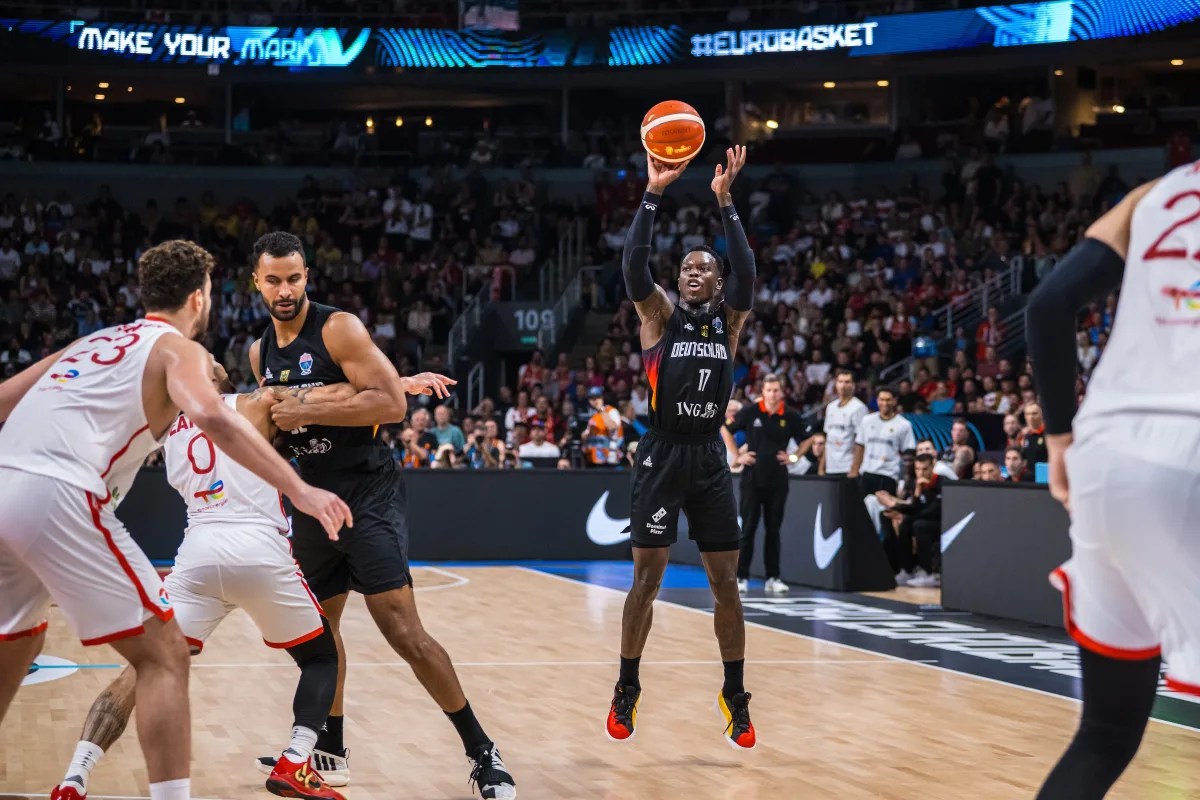
Pic credit: FIBA
Florian Flabb is a German coach who currently is coaching Pro B team Orange Academy and the ratiopharm Ulm NBBL team He began his coaching career as an assistant with the Art Giants and then was a head coach with the NBBL and Pro A team. He also has been an assistant coach with the German U-18 and U-20 teams. He spoke to germanhoops.com about the success of German basketball.
Thanks Florian for talking to germanhoops.com Germany is Euro Champion 2025. What kind of a feeling does this give you involved with German basketball?
It’s an incredible and historic moment for German basketball. Winning the World Cup in 2023 was already a milestone, but becoming EuroBasket champions in 2025 cements Germany’s place among Europe’s elite. This achievement reflects how far the program has come – from simply aiming to reach the knockout stages to now competing with and defeating traditional powerhouses. The team’s success is built on leadership from Dennis Schröder, the versatility of the Wagner brothers, and a remarkable team chemistry. I hope this title will inspire a new generation of players and spark a true basketball boom in Germany.
Is it crazy to have predicted a Gold medal before the tournament started? If you had to guess how many German basketball fans out of 10 would have predicted the Gold before the tournament how many would it have been under your estimation?
It wasn’t crazy, but definitely bold to predict gold before the tournament. Germany entered as World Champion, yet with strong rivals like Greece with Giannis Antetokounmpo, Turkey with Alperen Sengün, Slovenia with Luka Doncic, and Serbia with Nikola Jokic. If I had to estimate, I’d say about 3 out of 10 German basketball fans would have confidently predicted a gold medal beforehand. Most probably expected a podium finish – silver or bronze – while seeing a second consecutive major title as more of a dream than a realistic expectation.
It was the 2 best teams in the tournament with Germany and Turkey at 8-0. Was this the top final compared to the 1993 final vs Russia and 2023 final vs Serbia?
Wow, that’s a really tough question — mostly because I was only two years old at the time! My memory from back then is mostly bottles and nap times, so I can’t give you a first-hand comparison. But looking at the numbers and highlights, Germany and Turkey both coming in 8- 0 made it feel like a true clash of titans. Compared to the legendary 1993 win over Russia and the 2023 World Cup final vs. Serbia, this one was probably the highest level basketball Germany has ever played — even if toddler-me had no idea it was happening!
How did you experience the final. The game was a real dog fight with Turkey leading by as much as 11 points and being very strong. What got Germany the Gold medal after 40 minutes.
Looking back now, that final was nothing short of epic. It was a real dogfight right from the tip-off. Turkey came out incredibly strong, using their size and physicality to set the tone, and at one point they were up by 11 points. Their half-court execution and rebounding really had Germany struggling to find their rhythm early on. What ultimately won Germany the gold medal was the depth and balance of their roster. While Turkey leaned heavily on a few star players, Germany kept coming in waves. No matter who was on the floor, the energy and intensity never dropped. This allowed them to maintain their blistering pace, wearing Turkey down as the game went on. By the fourth quarter, you could see the difference: Turkey’s legs were heavy, while Germany was still flying up and down the court, moving the ball quickly and finding open looks. Their team chemistry and collective belief turned the tide. Over the final minutes, Germany’s depth overwhelmed Turkey, and that relentless team effort sealed one of the most hard-fought victories in German basketball history.
There has always been talk about the intense mentality, great team character and togetherness of Germany the last years. How does one keep developing it and not losing it over time?
It all comes down to culture and leadership. Veterans and coaches have to live those values every single day, setting the tone for all players. Dennis Schröder, as team captain, embodies that role perfectly — he’s the emotional leader and sets the standard with his work ethic and competitiveness. When someone like Tristan da Silva, a young NBA player, joins the squad, he immediately sees that environment and understands that no one is bigger than the team. This clarity makes it easy for new players to buy into the system. The group has created such a positive atmosphere that even established NBA stars describe the national team as a “Klassenfahrt” — a school trip — because they genuinely enjoy spending time together. It’s become a place where everyone wants to be in the summer, which is rare at the international level and a huge reason for Germany’s continued success.
There was a time in the 80s and 90s where you said in German football and after 90 minutes Germany always wins. I feel like there is this mentality now in German basketball. I was never fearing a los in the fourth quarter even when Turkey was up by 6 points.
Back in the 80s and 90s, people said in football, “Am Ende gewinnen immer die Deutschen” — in the end, Germany always wins. Today, that same winning mentality defines German basketball. Even when Turkey led by six points in the fourth quarter of the EuroBasket 2025 final, there was no panic — just trust and belief. Germany’s strength lies in having so many players who can step up, always putting the team’s success over individual performances. Back-to-back titles have built a calm, relentless confidence that Germany will always find a way to win.
What was key down the stretch that Germany could win the game. How much of a factor was the deep bench of Germany?
Down the stretch, the key was Germany’s depth and relentless pace. While Turkey relied heavily on a few stars, Germany kept sending out fresh lineups without losing quality or energy. That constant wave of players allowed them to push the tempo, forcing Turkey to defend at full speed while their own legs started to tire. In the final five minutes, this depth really showed. Germany could switch lineups, keep the defensive intensity high, and still find players ready to make big plays — not for personal glory, but to execute perfectly as a group. The bench wasn’t just a factor — it was the decisive advantage. It allowed Germany to stay aggressive, wear Turkey down, and ultimately close the game with the same speed and precision they had started with. That’s why, when it mattered most, Germany looked fresher and more composed, sealing another historic gold medal.
How valuable was Franz Wagner for this tournament. How is he a better player now than in 2023 despite 2 years of more experience?
Franz Wagner was invaluable to Germany’s EuroBasket 2025 run. He wasn’t just a scorer — he was the engine that kept the team’s fast-paced style running smoothly. His versatility allowed Germany to play position less basketball at times, switching seamlessly between roles on offense and defense. Compared to 2023, Franz is now a more complete player. Two more years in the NBA gave him sharper decision-making and a deeper understanding of when to take over and when to facilitate. Back in 2023, he was already a rising star, but at EuroBasket 2025 he played like a true leader, reading the game perfectly and elevating his teammates. What makes him special is that his growth hasn’t been just about individual stats — it’s about making Germany’s team game stronger. His improved defense, court vision, and maturity turned him into the ultimate connector, the kind of player who makes everyone around him better while staying completely committed to the group’s success.
Isaac Bonga continues to grow as a player since coming back from the NBA? Shouldn´t a tournament like this and especially how his game has developed the last 3 years give him another NBA opportunity?
Absolutely. Isaac Bonga has been one of the quiet success stories of German basketball over the last few years. Since returning from the NBA, he’s transformed his game — becoming more confident offensively while still being that versatile defender who can guard multiple positions. At EuroBasket 2025, his impact was huge, even if it didn’t always show up in the box score. He brought defensive stability, length, and energy, and his improved shooting and playmaking gave Germany even more lineup flexibility. He’s exactly the type of glue guy every coach loves — someone who makes winning plays without needing the spotlight. Given how his game has evolved over the past three years, it’s hard to imagine NBA teams not taking notice. A tournament like this proves he can thrive at the highest international level, and with his skill set and size, he definitely deserves another shot in the league — this time as a more mature and complete player.
You either like or dislike Dennis Schroeder, but he came up big in the second half after being closed down well in the first half. How do explain his unbelievable ability to be able to turn around the level and play like a winner when his team needs it most?
Dennis Schröder is one of those players who thrives under pressure. You either love his style or you don’t, but you can’t deny his impact. In the EuroBasket 2025 final, Turkey came in with a clear game plan — they double-teamed him constantly, cutting off his driving lanes and trying to frustrate him. Instead of forcing bad shots, Dennis showed his maturity and leadership. He focused on getting his teammates involved, using the extra attention on him to create open looks for others. This unselfish approach kept Germany’s offense balanced and wore Turkey’s defense down. Then, in the second half, when the game was on the line, he flipped that winner’s switch. With Turkey tiring, he started picking his spots, pushing the pace, and attacking when the moment was right. His ability to read the game, stay patient, and then take over when needed is what separates him from most players. Dennis Schröder has shown over the last few years what an incredible leader he is for Germany. The key isn’t just his talent, but how brilliantly the German coaching staffs has used him. They’ve built a system that maximizes his strengths — his speed, playmaking, and competitive fire — while surrounding him with players who perfectly complement his game. What really stands out is how the entire team has bought in. Every player accepts their role and trusts Dennis as their leader. Whether he’s being double-teamed and creating for others, or taking over in crunch time, the group follows his lead without ego or hesitation. That level of acceptance and togetherness is rare at the international level. It’s why Germany has been able to play as such a unified, unstoppable unit, turning individual talent into collective success — and why they’ve built a golden era for German basketball.
Dirk Nowitzki has been the GOAT of German basketball for more than 15 years. With the World and Euro won, Is Dennis Schroeder at Nowitzki´s level in terms of being in the same category as him?
Dirk Nowitzki will always be a legend, not just in Germany but globally. For more than 15 years, he carried German basketball on his shoulders, inspiring a whole generation and showing that a German player could be a true NBA superstar. His impact went far beyond medals — he changed the game and the perception of German basketball forever. Dennis Schröder’s path is very different. He hasn’t had Dirk’s NBA dominance, but on the international stage, his résumé now speaks for itself: World Champion in 2023 and EuroBasket Champion in 2025, both as the unquestioned leader of the team. So while Dirk remains the GOAT, Dennis has earned a place right beside him in the national team’s history. Dirk was the trailblazer, the icon. Dennis is the floor general who turned Germany’s potential into historic team success. You could say Dirk built the foundation — and Dennis led the group that climbed to the very top of the mountain. They’re different types of legends, but they now share the same elite category in German basketball.
One of the big winners was your colleague Alan Ibrahimagic went from assistant coach to Euro head coach winner. How valuable was his input? What do you believe could he still give a team that already had all the pieces of being a winning team?
Alan Ibrahimagic’s rise has been one of the great stories of this tournament. Going from assistant coach to leading Germany to a EuroBasket title is an incredible achievement, but it’s not just about winning — it’s about how he handled everything around him. In a brutal, high-pressure atmosphere, where scrutiny and second-guessing are constant, Alan never made it about himself. He kept everything regarding his own role quiet, shielding the team from outside noise. His selflessness and humility allowed the players to stay locked in on what truly mattered — playing their game and chasing gold. Germany already had the talent and depth to be a championship team, but Alan provided the calm and focus to bring it all together. He managed personalities perfectly, emphasized speed and ball movement, and created an environment where every player felt valued. By filling his role perfectly, without ego or drama, he gave the team exactly what it needed: a steady hand and a clear vision. That approach was crucial, especially when Germany fell behind by 11 points in the final against Turkey. His leadership kept the group composed, and ultimately, it helped turn talent into a historic championship run.
There were some nice plays in the final like Isaac Bonga´s dunk or Franz Wagner´s mega block. What was your favorite play of the final?
Oh, there were so many unforgettable moments — Bonga’s dunk that brought the bench to its feet, Franz Wagner’s monster block that completely shifted the momentum — but my favorite play was actually a lot less flashy. It came late in the fourth quarter when Germany was up by just two points. Turkey tried to trap Dennis Schröder near half court, but instead of forcing the action, he calmly swung the ball. Within seconds, it touched four different players’ hands, ending with a wide-open three from the corner. It was the perfect example of Germany’s unselfishness, depth, and speed — five guys moving as one unit, trusting each other completely. That play summed up why Germany won gold. It wasn’t about one hero moment, but about a team working in perfect harmony, making the right basketball play at the most important time.
Can one compare Germany´s success now with Spain from 2006-2011 where it won a World Cup and 2 Euro championships. Does Germany have a dynasty?
It’s a very fair comparison. Spain’s golden era from 2006 to 2011, when they won a World Cup and back-to-back EuroBasket titles, was built on incredible talent, depth, and a shared identity. What Germany has achieved now — World Champion in 2023 and EuroBasket Champion in 2025 — is starting to look a lot like the beginning of a similar dynasty. The ingredients are there: a deep roster with multiple NBA players, incredible chemistry, and a winning culture where everyone buys into their role. What makes Germany especially dangerous is that so many of their key players — like Franz Wagner and Tristan da Silva — are still very young, while experienced leaders like Dennis Schröder and Daniel Theis are setting the tone. To truly match Spain’s run, Germany will need to sustain this level through the 2027 World Cup and EuroBasket 2029. But right now, they’ve created an environment where every summer feels like a “Klassenfahrt” — a place where top players want to come back, compete, and win together. This dynasty should go on.
The future still looks good with a nucleus of the Wagner brothers, Tristan Da Silva, Andi Obst, Isaac Bonga and Isaiah Hartenstein plus the new wave of guys like Ivan Kharchenkov, Hannes Steinbach, Johan Grunloh, Christian Anderson and others. Does Germany have the mentality to keep it going with the new wave of players that you have seen the last years?
Germany has laid the foundation for something truly special. Winning the 2023 World Cup and the 2025 EuroBasket has put them at the very top of international basketball, but the real challenge now is staying there consistently. The current core — Franz and Moritz Wagner, Tristan da Silva, Andi Obst, Isaac Bonga— has proven what it takes to win: a group built on selflessness and unity, where no one plays for individual glory. They’ve created a place where players genuinely want to return each summer. The next wave is coming fast, with young talents like Ivan Kharchenkov, Hannes Steinbach, Johan Grünloh, and Christian Anderson ready to join the program. But you can’t predict how these big talents will develop over the next few years. It takes more than skill — injuries, mindset, role acceptance, and team chemistry all have to come together to keep this incredible level of success going. If the core group manages to pass down their winning mentality and the young players embrace the culture, Germany has every chance to remain among the world’s elite. It’s not a dynasty yet, but the pieces are in place — now it’s about sustaining the hunger and making sure the next generation carries the torch forward.
You coach young men and are right there seeing the work and effort. Often now adays the talk is young players aren´t as hungry as back in the day. In other words players today aren´t challenged enough with too many outside influences. What makes young German players different than young players from other countries in this generation?
That’s a very tough question. It’s easy to say that today’s young players aren’t as hungry or as challenged as they were “back in the day,” with so many outside influences and distractions, but I think the situation in Germany is a bit different. Over the last decade, Germany has invested heavily in the entire ecosystem around basketball — not just facilities and gyms, but also coaching, youth development programs, and sports science. Young players are surrounded by an environment that teaches them professionalism early on and gives them the tools to grow, both on and off the court. We’re starting to see the results now. Players coming through the system understand what it takes to compete at the highest level, and they have role models like Dennis Schröder, Franz Wagner, and Isaac Bonga showing them the path. Of course, you can never fully predict how young talent will develop, but these investments have created a culture where the hunger to succeed is nurtured, and the focus stays on the team and the game itself, rather than the distractions around it.
Thanks Florian for the chat.
 German Hoops